From Idea to Investment: Four Climate Finance Lessons from WUF13
The urban climate finance gap is not a shortage of ideas; it is a shortage of pathways from ideas to investment.
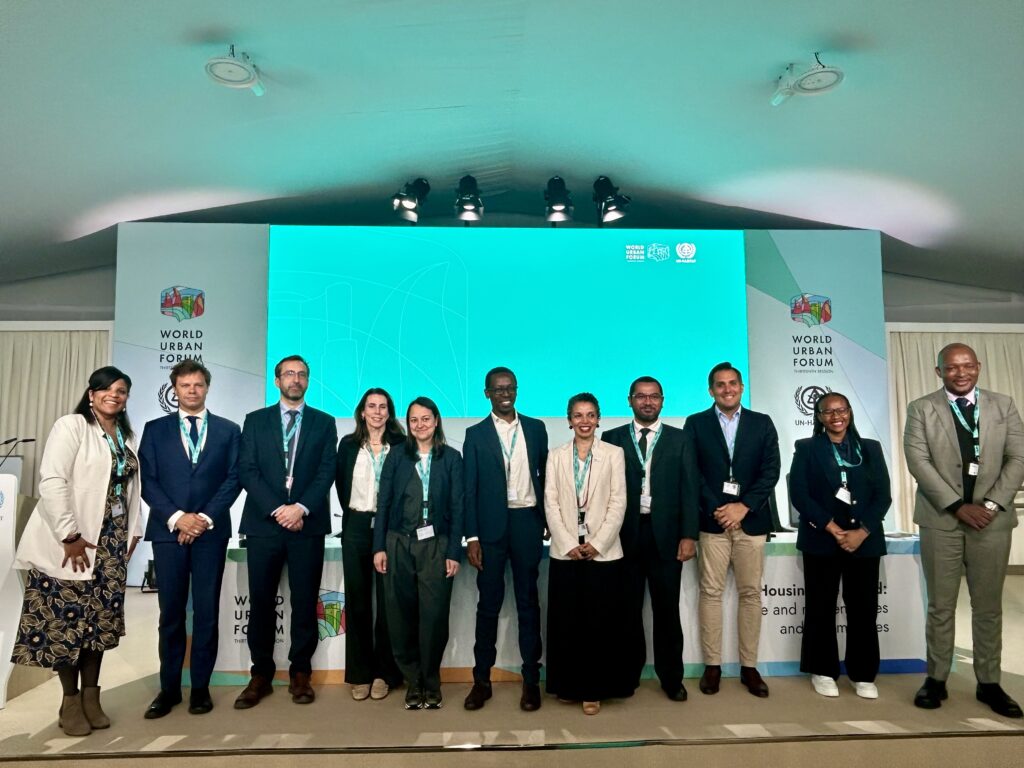
This message was made clear by Dr Maimunah Mohd Sharif during her opening remarks at the session Innovative Models to Unlock Finance for Climate-Resilient Housing and Basic Services in Intermediary Cities co-organized by the Global Covenant of Mayors for Climate and Energy (GCoM)-Gap Fund Partnership and the National Development Banks Urban Climate Action Programme (NUCA), together with UN-Habitat’s Cities Investment Facility (CIF) at the World Urban Forum 13 (WUF13) in Baku, Azerbaijan. As advisor on Sustainable Urbanization to the Government of Malaysia, former Mayor of Kuala Lumpur and former Executive Director of UN-Habitat, Dr. Sharif reminded participants that cities are not short on ambition. What they often lack is the early-stage support needed to transform climate-related ideas into robust, credible, and investment-ready projects, as well as a clearer understanding of financing options and stronger connections with technical and financial partners.
Across four WUF13 sessions, Gap Fund partners explored a critical question: what does it take for cities to move from climate ambition to finance-ready investment? Four clear lessons emerged from the discussion:
Cities need financing pathways from the earliest stages
Financial intermediaries are essential to scale urban climate finance
Stronger coordination among multilateral development banks, City networks and project preparation facilities is essential and already taking shape
Local capacity remains the foundation of robust projects
Across these discussions, the GCoM-Gap Fund Partnership has once again demonstrated its ability to act as a bridge between local governments and climate finance opportunities, helping cities connect early-stage project ideas with the institutions that can support their journey toward investment.
1. Supporting cities to define the right financing pathways
A defining takeaway from WUF13 is that project preparation must begin by addressing who will pay for the project, and under what conditions. As Augustin Maria, Global Lead for Cities and Climate Change at the World Bank and Program Manager for the City Climate Finance Gap Fund, noted, cities need to think about financing pathways from the earliest stages of project development.
This means identifying what municipal resources may be available, who can provide technical support, who could finance feasibility studies, which institutions might eventually invest, and what type of public, private or blended financing model may be realistic. This is where GCoM plays a critical bridging role – by clarifying project ideas, strengthening investment readiness and connecting early-stage concepts with the right technical and financial partners.
The sessions organized by the GCoM-Gap Fund Partnership team showed that there is no single route from local needs to financing. For example, the city of Tshwane (South Africa) highlighted the enabling conditions required to attract investment into climate-resilient housing and basic infrastructure. Bogotá (Colombia) shared experience in mobilising private capital through urban renewal and land-based instruments, while PT Sarana Multi Infrastruktur (Indonesia) showed how financial intermediaries can help municipalities structure projects and access suitable financing channels.
2. Recognizing the strategic role of financial intermediaries
National development banks and financial intermediaries are essential actors in urban climate finance. They can help translate city priorities into investment pipelines, aggregate smaller projects, reduce transaction costs, structure financing options and connect local demand with domestic and international capital.
The challenge lies in involving financial intermediaries earlier and more strategically in the project preparation process. During a session moderated by Melissa Kerim, Regional Lead for Africa at the GCoM-Gap Fund Partnership, two initiatives dedicated to strengthening the role of financial intermediaries in urban climate finance were highlighted, namely the Financial Intermediaries Cities Climate Action Programme (FICCAP) and the NUCA Programme.
Launched under the Gap Fund, FICCAP equips financial intermediaries with the skills, tools and pipelines needed to turn city climate ambitions into investable opportunities. In parallel, NUCA, managed by the International Development Finance Club, complements by strengthening the role of national and regional development banks in urban climate finance. GCoM has been working closely with these two initiatives to help advance beyond isolated project ideas toward structured, scalable and finance-ready investment pipelines.
3. Aligning MDB efforts to move projects beyond pre-feasibility
At WUF13, a shared consensus emerged among multilateral development banks, city networks, and project preparation facilities: the only way forward is through radically stronger coordination.
The MDB Roundtable on sustainable local housing highlighted the immense value of collaboration between the World Bank, the European Investment Bank, and GCoM through the Gap Fund. Invited to share the voice of cities, Johanna Z. Granados Alcala, Global Head of the GCoM-Gap Fund Partnership, spoke alongside representatives from the African Development Bank (AfDB), Asian Development Bank (ADB), European Investment Bank (EIB) and European Bank for Reconstruction and Development (EBRD). Together, these partners emphasized how such collaboration improves project identification, strengthens direct engagement with cities, and creates a feedback loop for banks to better understand local needs and constraints.
Similarly, the session ‘Financing System-Wide Urban Resilience,’ organized by the Multilateral Development Banks (MDB) Cities Group, C40 Cities and GCoM, explored how MDBs can better finance resilience across urban systems. It showcased concrete examples of coordination around pipeline sharing, co-financing and joint knowledge activities, with the aim of joining forces to support projects from upstream preparation to downstream investment.
4. Strengthening city capacity: the foundation for success
Finally, finance means little without local capacity. This principle is central to the GCoM-Gap Fund Partnership’s long-term capacity-building work with cities, and was also at the heart of the WUF13 Academy training on climate-resilient Nature-based Solutions. Organized by ICLEI, GIZ and EIB, the training guided municipal leaders through the project preparation lifecycle and explored practical tools to identify, prioritize and finance urban resilience projects.
This training built on the extensive foundation of the GCoM-Gap Fund Partnership, which has delivered more than 100 capacity-building activities since 2023. These efforts include workshops, webinars and peer-to-peer learning sessions across Africa, Southeast Asia, Latin America and the Caribbean, Central and Eastern Europe, and the Middle East and North Africa.
WUF13 reaffirmed that cities, development banks, financial intermediaries and project preparation facilities each hold part of the solution. The value of a “One Gap Fund” approach is to bring these actors together earlier, align support more effectively, and help cities move from promising ideas to technically credible projects, financially structured and ready for investment.
Cities May Be Our Greatest Hope in the Face of Climate Change and the PandemicFebruary 19, 2021
Page Navigation
We care about your privacy
The Global Covenant of Mayors for Climate and Energy uses some
necessary cookies which
are required for our website to function. By
accepting all cookies
you consent to the use of additional cookies to analyze site traffic and online behavior.
You can manage cookies
or withdraw your consent at any time.
This does not affect the lawfulness of the use of these cookies prior to withdrawal.
For more information read our
Cookie Policy.
These cookies are necessary for the website to function and cannot be switched off in our
systems.
They are usually only set in response to actions made by you which amount to a request for
services,
such as setting your privacy preferences, logging in or filling in forms. You can set your
browser
to block or alert you about these cookies, but some parts of the site will not then work. These
cookies do not store any personally identifiable information.
These cookies are necessary for the website to function and cannot be switched off in our
systems. They are usually only set in response to actions made by you which amount to a request
for services, such as setting your privacy preferences, logging in or filling in forms. You can
set your browser to block or alert you about these cookies, but some parts of the site will not
then work. These cookies do not store any personally identifiable information.
These cookies allow us to count visits and traffic sources, so we can measure and improve the
performance of our site. They help us know which pages are the most and least popular and see
how visitors move around the site. All information these cookies collect is aggregated and
therefore
anonymous. If you do not allow these cookies, we will not know when you have visited our site.
Cookie
Provider
Type
Duration
Description
_pk_id
Matomo Analytics
13 months
Used to store a few details about the user such as the
unique visitor ID
_pk_ses
Matomo Analytics
30 minutes
Short lived cookies used to temporarily store data for
the visit
viewed_cookie_policy
www.globalcovenantofmayors.org
persistent
6 months
Used to note whether you have viewed the cookie policy