LOCAL GOVERNMENTS AND DEVELOPMENT FINANCE INSTITUTIONS PARTNER TO INCREASE SUPPORT FOR RESILIENT URBAN INFRASTRUCTURE INVESTMENT
High-level discussion among DFIs and city leaders lays the groundwork for new solutions to increase investment in resilient, low-carbon urban infrastructure
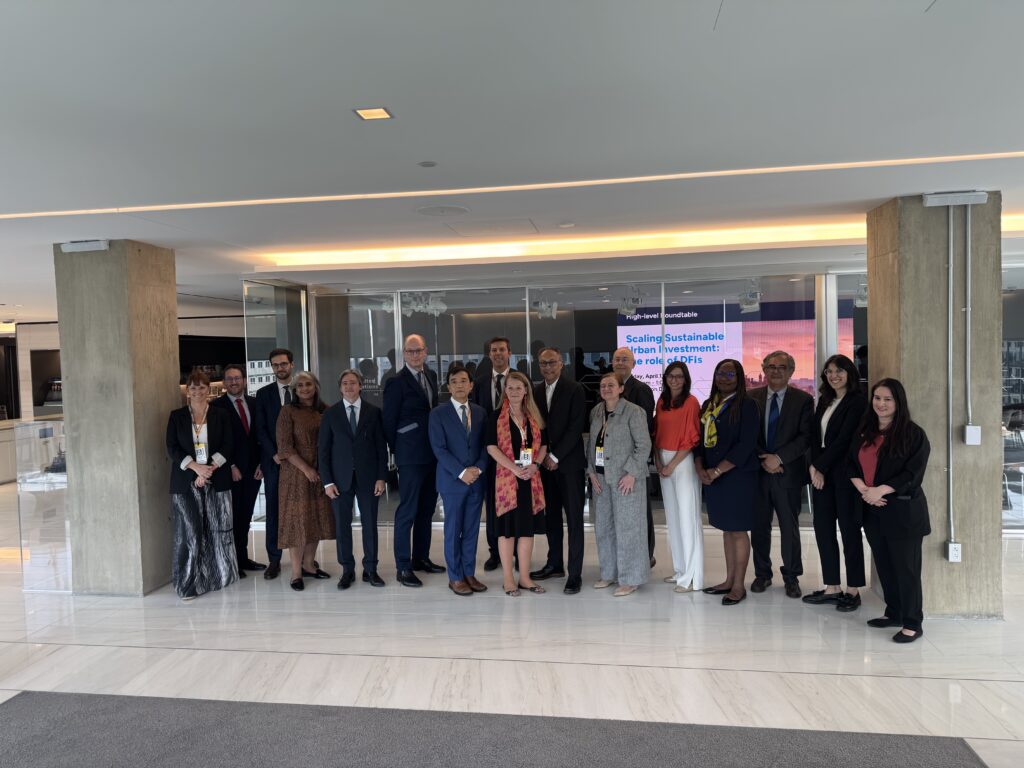
Washington, D.C., USA, April 17, 2026 – Mayors and Development Finance Institutions (DFIs) met during the World Bank Spring Meetings for the high-level roundtable “Scaling Sustainable Investment in Cities: The Role of DFIs”. Co-convened by C40 Cities and the Global Covenant of Mayors for Climate & Energy (GCoM) in partnership with the Multilateral Development Banks (MDBs) Cities Group – a task force formed by the urban teams from eight MDBs -, the gathering focused on how DFIs can accelerate finance flows to cities for efficient and resilient urban development, how to strengthen enabling policies, and how to better support small and intermediate cities, which are usually the most impacted by external shocks.
The conversations highlighted the progress made by DFIs to scale urban climate finance and identify how to increase this effort and translate it into practical solutions to address even more persistent finance gaps, particularly for cities in the Global South. Among others, the roundtable featured lessons from the recently formed Latam Chief Financial Officer (CFO) Network, which convenes municipal finance leaders across Latin America and the Caribbean to share experiences and strengthen capacities to better fund and finance sustainable and resilient urban infrastructure.
Juan Pablo Bonilla, Manager of the Climate Change and Sustainable Development Sector, Inter-American Development Bank, said:
“Cities are where investment becomes impact. Through the LAC City Finance Secretaries Network, the Inter-American Development Bank supports a city‑led agenda that brings finance leaders together to tackle structural barriers to financing urban resilience. In partnership with C40 Cities, the IDB serves as Technical Secretariat, supporting cities through capacity building to strengthen financial management, improve access to financing, and develop shared tools and solutions. The Network fosters peer‑to‑peer collaboration, enabling cities to turn shared challenges into practical solutions for mobilizing and managing resources more effectively.”
MDBs are also scaling long-standing programs that support cities in delivering sustainable and resilient infrastructure, while deepening collaboration with city networks and partners to expand impact and reach.
Mark Bowman, Vice President for Policy and Partnerships, European Bank for Reconstruction and Development (EBRD), said:
“The year of 2026 marks ten years of EBRD Green Cities, a decade of helping cities build greener, more resilient infrastructure that makes a tangible difference to people’s lives. As pressures mount, from natural hazards and energy insecurity to sudden economic shocks, this work has never been more urgent. Guided by our new Green Economy Strategy, we are raising our ambition: expanding and deepening support under the programme to reach a total of 100 million people across our countries of operation, including those who have recently joined in Sub-Saharan Africa. With a strengthened approach, updated methodology, and deeper partnerships across city networks and multilateral development banks, EBRD Green Cities is ready for its next decade – because the challenges cities face demand coordinated action, shared knowledge, and bold innovation.”
The high-level dialogue also gathered representatives from national governments such as Brazil and Germany, co-chairs of the Coalition for High Ambition Multilevel Partnerships (CHAMP) – a global initiative to strengthen collaboration between national governments and local authorities in delivering climate action.
The CHAMP Coalition co-chairs represented by Ulf Jackel, Head of International Adaptation to Climate Change, BMUKN (Germany) and Ambassador Antonio Da Costa, Head of International Affairs, Ministry of Cities (Brazil), jointly stated:
“Delivering climate action at scale requires strong and sustained partnerships between all levels of government. National governments play a critical role in creating the enabling conditions, through policy, regulation and planning, but implementation ultimately happens at the local level. Germany and Brazil are proud to co-chair the CHAMP coalition as we enter this exciting new phase of country-led governance. As co-chairs, we call on MDBs and DFIs to actively work with us to remove financial bottlenecks and to ensure that cities are better equipped to access and deploy climate finance. Together, we can scale-up urban investment and deliver tangible results for communities and support sustainable and resilient urban development.”
“Closing the climate finance gap is not only about increasing volumes, but about building a system that can deliver investment at scale and where it is most needed. The 4th IHLEG report outlines a feasible pathway to significantly expand finance by aligning public and private capital, strengthening enabling environments, and focus on implementation. And as underscored in COP30’s Baku to Belém Roadmap, cities are central to this effort: they are where investment translates into real outcomes. Strengthening the financial case, improving access, and connecting projects to capital markets will be critical to turning ambition into delivery on the ground.”
Claudio Castro, mayor of Renca, Chile, and member of the Mayors’ Forum of the Global Covenant of Mayors for Climate & Energy (GCoM) in Latin America, said:
“In Renca, we did not wait for international finance to solve our climate crisis. We chose to act: we transformed treated industrial water, previously discharged into the sewer system, into a self-sufficient irrigation network for an urban park that will become a major green lung for the entire Metropolitan Region of Santiago. This project will allow us to quadruple our green space per capita and is expected to reduce temperatures by up to 4°C. We have advanced this through a public-private partnership, with strong municipal leadership and local innovation. And the results are clear: for every dollar invested in the Parque Metropolitano Cerros de Renca irrigation system, we estimate a return of 26 dollars. This shows that climate action is not only a social imperative, but also an investment opportunity. That is why our call is to move forward together. If cities like Renca are already developing concrete solutions with proven impact and returns, it is essential that national governments and international financial institutions continue strengthening the conditions that enable more cities to access this kind of financing. Local ambition is there; the challenge is to keep building a financial architecture that can match it.”
The dialogue brought together senior representatives from leading multilateral development banks, including Ludger Schuknecht, Vice President of Policy and Strategy at the Asian Infrastructure Investment Bank (AIIB); Mark Bowman, Vice President for Policy and Partnerships at the European Bank for Reconstruction and Development (EBRD); Christian Asinelli, Vice President of Strategic Programming at the Development Bank of Latin America and the Caribbean (CAF); Ambroise Fayolle, Vice President at the European Investment Bank (EIB); Ming Zhang, Global Director for Urban, Subnational Finance, Tourism and Disaster Risk Management at the World Bank Group (WBG); Juan Pablo Bonilla, Managing Director of the Climate Change and Sustainable Development Sector at the Inter-American Development Bank (IADB); Nicolas Picchiottino, Secretary General, Head of Public Banks at International Development Finance Club (IDFC); and Norio Saito, Senior Sector Director for Water and Urban Development at the Asian Development Bank (ADB).
New report: making the city-case for urban adaptation finance
During the roundtable, a new report, “Building the Financial Case for Urban Adaptation: Guidance and Case Studies,” was launched by C40 Cities in partnership with the Global Covenant of Mayors for Climate & Energy (GCoM). The analysis provides a practical roadmap to help cities unlock private investment for climate adaptation projects, based on case studies that have been implemented.
By analysing what has worked in urban adaptation projects that have successfully mobilised private finance, the report demonstrates how cities can attract investment by developing project structuring strategies with clear revenue streams, investable project pipelines, and strong enabling conditions. It showcases successful models of privately financed urban adaptation and provides practical guidance on presenting projects that align with investor expectations.
The report supports cities in building a compelling case for private investment by equipping cities with the tools to structure projects, demonstrate returns, and reduce perceived risks. It helps shift adaptation from being seen solely as a public cost to a viable investment opportunity. Ultimately, it aims to accelerate the flow of finance to urban adaptation projects, particularly in cities most vulnerable to climate impacts. Andrea Fernández, Managing Director for Climate Finance at C40 Cities, said:
“Cities are the front lines of the climate crisis, yet the lack of accessible finance remains the single greatest barrier to action. With the launch of C40’s new report on urban climate finance adaptation, we are providing a roadmap to shift the narrative: adaptation is no longer just a public cost, it is a viable investment opportunity. By equipping cities with the tools to structure bankable projects and engage private investors early, we can unlock the private capital essential to meeting our global goals and ensuring a safer, more resilient future for urban residents.” The publication outlines a clear set of recommendations for cities to mobilise private finance for adaptation climate projects:
Align climate planning and finance functions and develop clear adaptation strategies and investment pipelines to create strong demand signals;
Engage private investors early in project design to ensure bankability and scale;
Build partnerships with private stakeholders to align on risks, returns and shared benefits;
Develop viable monetisation pathways, including tariffs, land value capture and blended finance structures;
Invest in project preparation capacity and strengthen transparency and reporting frameworks to bring projects to market and maintain investor confidence.
Examples of successful local climate initiatives highlighted in the report include:
Dakar, Senegal, the Bus Rapid Transit (BRT) system integrates flood-resilient infrastructure with private sector participation through a public–private partnership financing electric buses and systems;
Bilbao’s Zorrotzaurre redevelopment project, in Spain, combines public investment in flood protection with private real estate financing to create a flood-resilient urban district.
In Kuala Lumpur, Malaysia, the SMART Tunnel demonstrates how large-scale flood infrastructure can be delivered with private sector financing and expertise.
In the Netherlands, Afsluitdijk upgraded its flood defence mobilizing private finance through a long-term public–private contract to strengthen climate resilience against extreme sea-level events.
‘Cities Race to Resilience’ Campaign Launched to Mobilize Action Ahead of COP26 July 8, 2021
Page Navigation
We care about your privacy
The Global Covenant of Mayors for Climate and Energy uses some
necessary cookies which
are required for our website to function. By
accepting all cookies
you consent to the use of additional cookies to analyze site traffic and online behavior.
You can manage cookies
or withdraw your consent at any time.
This does not affect the lawfulness of the use of these cookies prior to withdrawal.
For more information read our
Cookie Policy.
These cookies are necessary for the website to function and cannot be switched off in our
systems.
They are usually only set in response to actions made by you which amount to a request for
services,
such as setting your privacy preferences, logging in or filling in forms. You can set your
browser
to block or alert you about these cookies, but some parts of the site will not then work. These
cookies do not store any personally identifiable information.
These cookies are necessary for the website to function and cannot be switched off in our
systems. They are usually only set in response to actions made by you which amount to a request
for services, such as setting your privacy preferences, logging in or filling in forms. You can
set your browser to block or alert you about these cookies, but some parts of the site will not
then work. These cookies do not store any personally identifiable information.
These cookies allow us to count visits and traffic sources, so we can measure and improve the
performance of our site. They help us know which pages are the most and least popular and see
how visitors move around the site. All information these cookies collect is aggregated and
therefore
anonymous. If you do not allow these cookies, we will not know when you have visited our site.
Cookie
Provider
Type
Duration
Description
_pk_id
Matomo Analytics
13 months
Used to store a few details about the user such as the
unique visitor ID
_pk_ses
Matomo Analytics
30 minutes
Short lived cookies used to temporarily store data for
the visit
viewed_cookie_policy
www.globalcovenantofmayors.org
persistent
6 months
Used to note whether you have viewed the cookie policy